
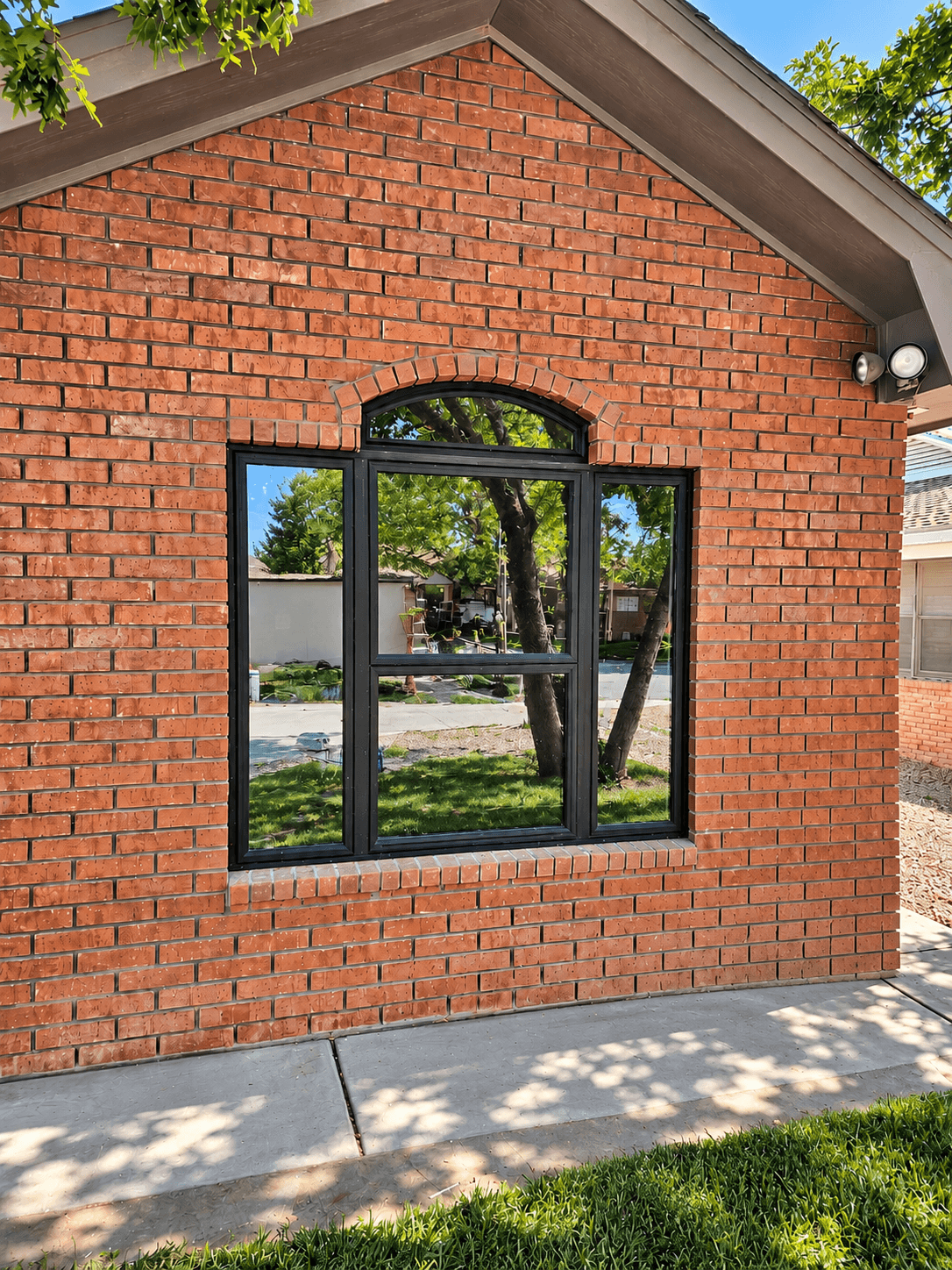
What window caulk actually does
Caulk is the flexible sealant that bridges the joint between your window frame and the surrounding wall, brick, or trim. Its job is to keep water, air, and insects out of that seam while allowing the small amount of movement that every house goes through as temperatures rise and fall.
Because it stays flexible to do that job, caulk is a wear item. Sun, heat, cold, and constant expansion and contraction break it down over time, which is why resealing is part of normal home maintenance rather than a sign that anything is wrong with the window itself.
1. You can see cracks, gaps, or shrinking
The clearest signal is visual. Walk the outside of your home and look closely at the bead of caulk around each window, especially along the top and sides where sun exposure is highest. Hairline cracks, gaps that have opened up, or caulk that has visibly shrunk and pulled away from the frame all mean the seal is no longer continuous.
2. The caulk is hard, brittle, or crumbling
Fresh caulk is soft and slightly springy. Old caulk goes the other way: it hardens, turns brittle, and can crumble or flake away when you press on it. Once it loses its flexibility it can no longer move with the house, so it cracks and fails even if it still looks mostly intact from a distance.
3. You feel drafts or notice higher energy bills
Failed caulk lets conditioned air leak out and outside air leak in. If you feel a draft near a closed window, or your heating and cooling bills are creeping up without another explanation, worn caulking around the frames is one of the common culprits and one of the easiest to check.
4. There are signs of water or moisture
Water stains on the wall or sill beneath a window, peeling paint that keeps coming back, discoloration, or dark mildew and mold along the seam all point to moisture getting past the seal. This is the most important sign to act on, because water that gets into the wall cavity can cause damage far more expensive than a tube of caulk.
- Water stains or streaking below the window
- Paint that peels or bubbles and returns after repainting
- Dark mildew, mold, or discoloration along the joint
- A musty smell near the window on humid days
How often should windows be recaulked?
As a general rule, exterior caulk lasts around five years, though quality sealant and milder conditions can stretch that longer. In climates with intense sun, wide temperature swings, or wind-driven rain and dust, it can wear out sooner. The best habit is a quick seasonal look at your window seams so you catch small gaps before they let water in.
Keep in mind that caulking and routine maintenance are considered normal upkeep and are not covered under a window warranty, so it is worth staying ahead of it.
When recaulking is not enough
Resealing solves a worn joint, but it cannot fix a window that has already failed. If you are also seeing fog or condensation between the panes, frames that are soft, cracked, or rotting, or windows that no longer open, lock, or seal properly, new caulk will only mask the larger problem. In those cases, replacement is the better long-term investment.
If you are not sure whether you are looking at a simple resealing job or a window nearing the end of its life, that is exactly the kind of thing our estimators check during a free in-home visit. We will tell you honestly which windows just need attention and which ones are worth replacing.
- #Windows
- #Caulking
- #Maintenance
- #Homeowner Guide